A proposal for Fluid Intelligence. Moving beyond the "Central Orchestrator Model" to decentralized, position-based agent coordination using biological stigmergy.
Current Multi-Agent Systems attempt to solve fluid problems with rigid structures. We face two primary architectural failure modes.
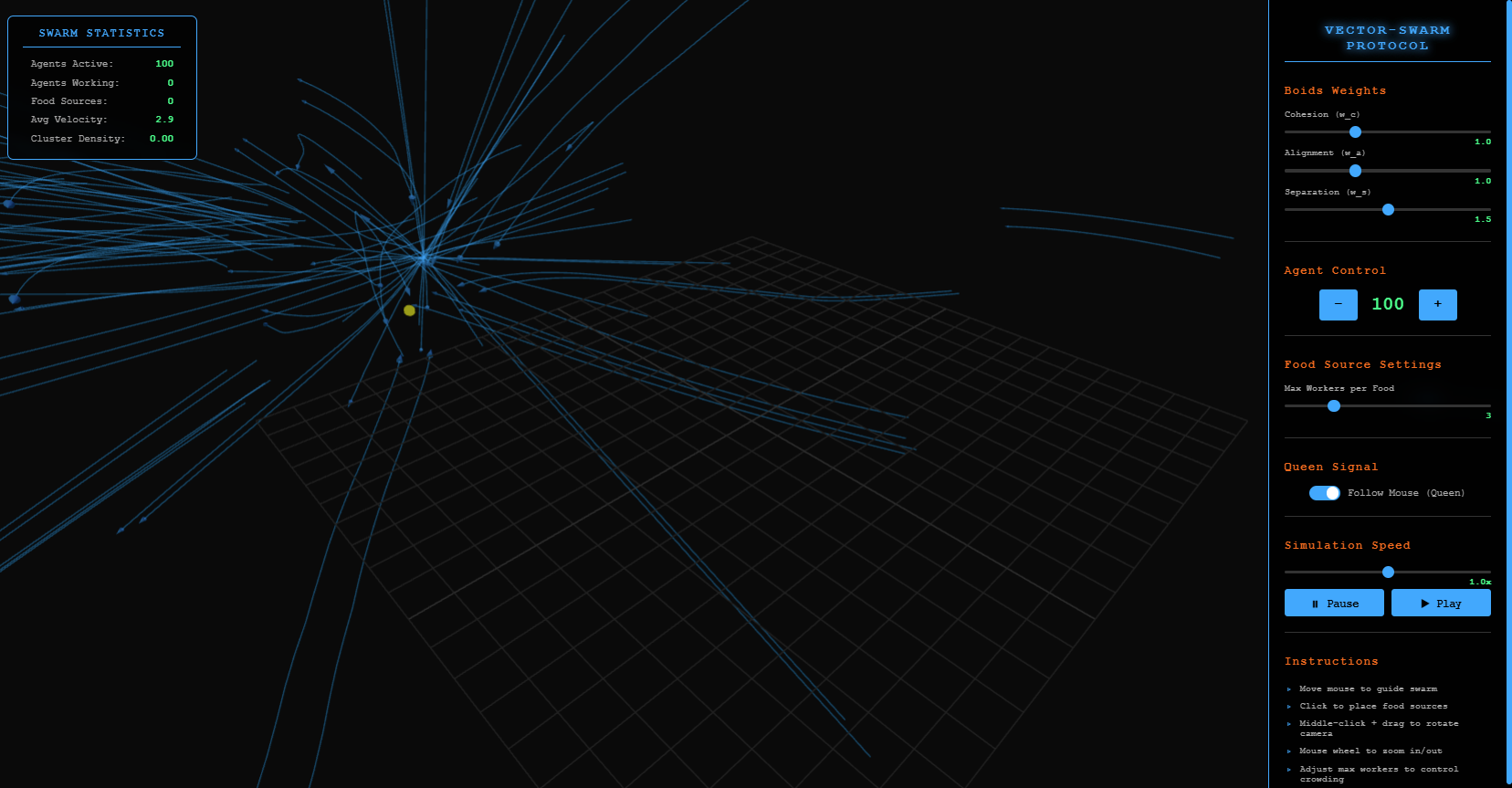
Instead of roles, we use positions. Agents follow three simple biological instincts relative to vectors in a database. Experience the swarm's behavior in real-time with our interactive 3D simulation.
How the next move is calculated.
V_next =
( w_mission · V_queen ) +
( w_flock · V_neighbors ) -
( w_crowd · V_body )
The agent does not "think"; it flows based on the sum of these inputs.
Immutable & Global
Defines the Problem Space. Like a pheromone trail to food, this vector is injected by the system to drive Cohesion. It prevents the swarm from drifting into unrelated tasks (hallucination).
Dynamic & Regional
Defines the Concept Space. The average direction of neighbors. If 5 agents are working on "SQL", the local vector shifts to "SQL", aligning new agents to the same tools and patterns.
Atomic & Specific
Defines the Local Space. Represents the specific task (e.g., "Row 45"). If another agent gets too close ($>0.95$ similarity), territorial pressure pushes them to a nearby gap.
By shifting from "Task Execution" to "Fluid Intelligence," we unlock properties impossible in static topologies.
If an agent crashes, local pressure drops, and neighbors naturally flow into the gap.
Hard problems emit "Stronger Scent", attracting more agents automatically.
Agents traversing space discover "glue work" (integration tests) that humans forgot to assign.