Technical Proposal • December 2025 • Quintin de Kok

Swarms Flocking Through Vector Space

A proposal for Fluid Intelligence. Moving beyond the "Central Orchestrator Model" to decentralized, position-based agent coordination using biological stigmergy.

Enter the Simulation → Read the Proposal

The Failure of Static Topology

Current Multi-Agent Systems attempt to solve fluid problems with rigid structures. We face two primary architectural failure modes.

1. The Central Orchestrator Model

  • × Bandwidth Limit: The Orchestrator becomes a serial bottleneck. Throughput caps at the speed of the central node.
  • × Round-Trip Latency: Local problems require global permission to solve. $O(1)$ becomes $O(N)$.
  • × Hallucination: Compression of worker state leads to low-resolution decisions by the "God" node.

2. The Cocktail Party

🗣️
  • × Coordination Tax: Communication overhead scales quadratically $O(N^2)$.
  • × Token Burn: Agents spend compute negotiating "Who does what?" instead of working.
  • × Context Pollution: Chatter pushes actual task data out of the context window.

The Solution: Vector-Space Stigmergy

Instead of roles, we use positions. Agents follow three simple biological instincts relative to vectors in a database. Experience the swarm's behavior in real-time with our interactive 3D simulation.
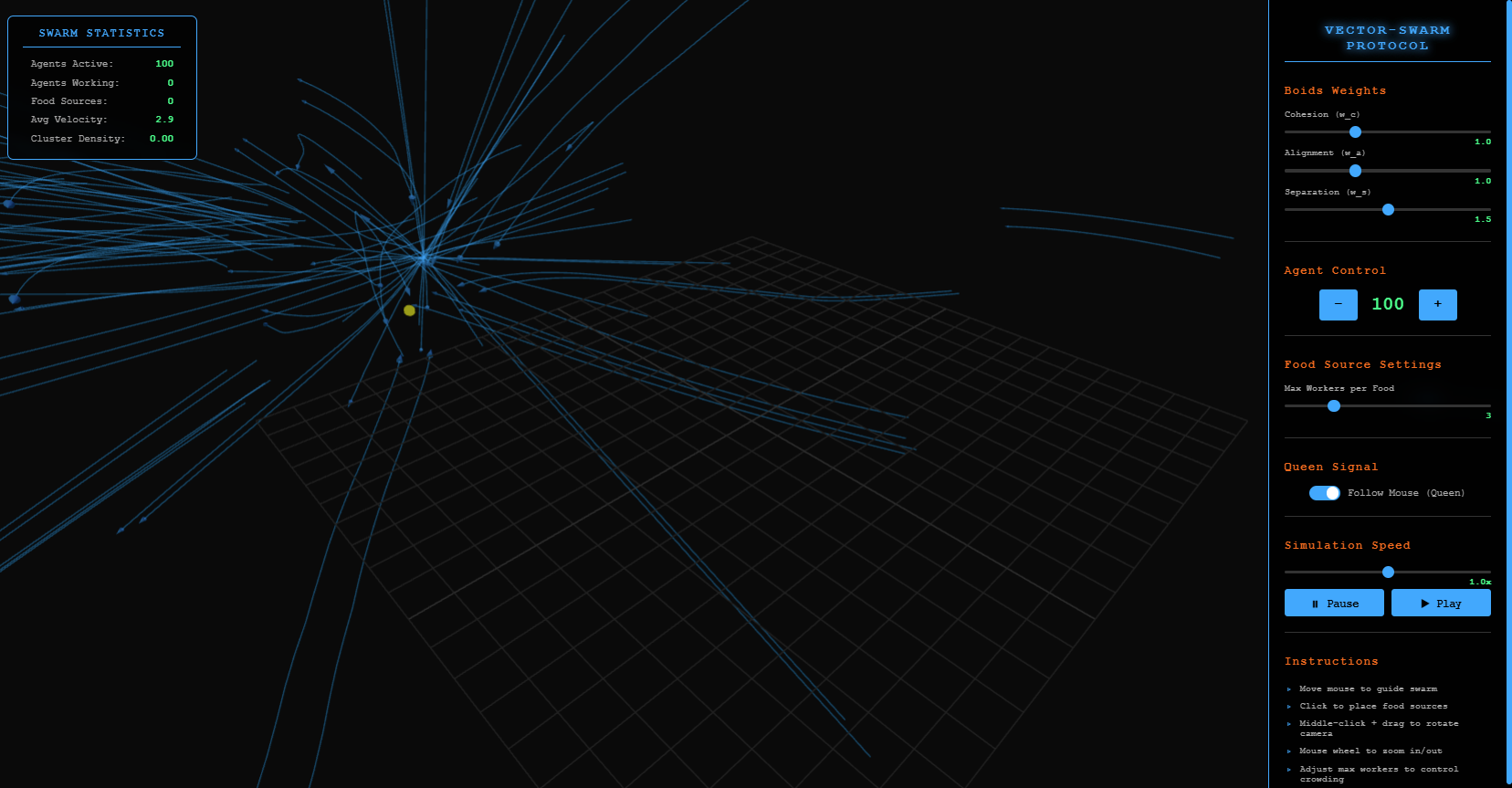
Vector-Swarm Protocol 3D Simulation
Features: Real-time 3D flocking • Adjustable Boids weights • Click to place food sources • Camera controls • Statistics overlay

The Tri-Signal Framework

How the next move is calculated.

V_next = ( w_mission · V_queen ) + ( w_flock · V_neighbors ) - ( w_crowd · V_body )

The agent does not "think"; it flows based on the sum of these inputs.

Layer 1: The Queen

Immutable & Global

Defines the Problem Space. Like a pheromone trail to food, this vector is injected by the system to drive Cohesion. It prevents the swarm from drifting into unrelated tasks (hallucination).

Layer 2: The Flock

Dynamic & Regional

Defines the Concept Space. The average direction of neighbors. If 5 agents are working on "SQL", the local vector shifts to "SQL", aligning new agents to the same tools and patterns.

Layer 3: The Body

Atomic & Specific

Defines the Local Space. Represents the specific task (e.g., "Row 45"). If another agent gets too close ($>0.95$ similarity), territorial pressure pushes them to a nearby gap.

Emergent Digital Ecosystems

By shifting from "Task Execution" to "Fluid Intelligence," we unlock properties impossible in static topologies.

  • 1

    Self-Healing

    If an agent crashes, local pressure drops, and neighbors naturally flow into the gap.

  • 2

    Auto-Scaling

    Hard problems emit "Stronger Scent", attracting more agents automatically.

  • 3

    Discovery

    Agents traversing space discover "glue work" (integration tests) that humans forgot to assign.

Architecture Performance Profile